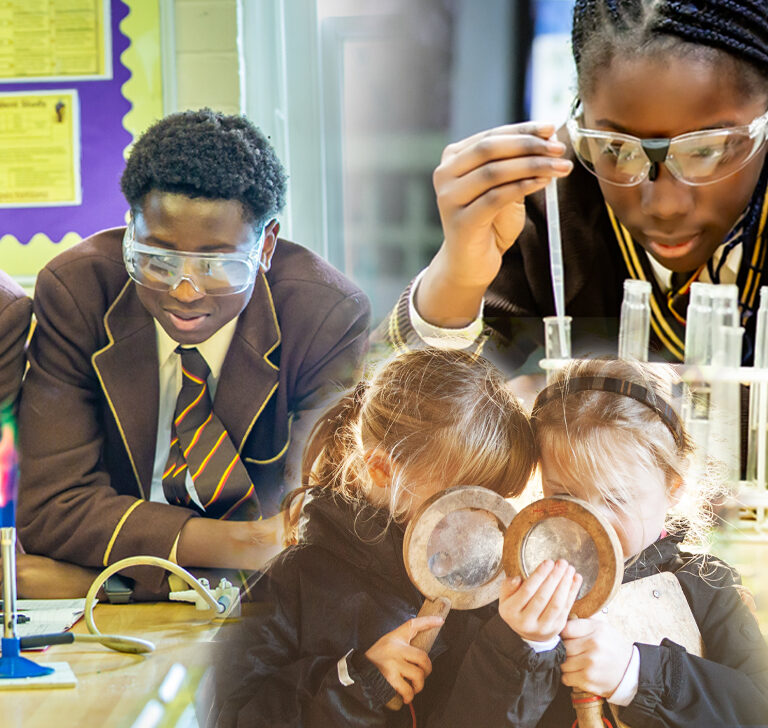
Science is a way of thinking; developing an understanding of the world around us and how we fit into the universe as a species and how technological advancements will enable the progress of humanity and the environment. From Kindergarten to Upper Fifth, we nurture curiosity through hands-on investigations, explorative learning, and real-world discovery. Our dedicated Junior Science Lab and year-round STEM Clubs provide exciting opportunities for children to experiment, question, and think independently. In Key Stage 3 and 4 students are taught by specialist teachers and the three separate subjects of Biology, Chemistry and Physics.
Lower School – Key Stage 1
Our approach includes high-quality resources, specialist equipment, and a strong focus on “working scientifically” from the earliest years. Differentiated tasks and enrichment activities ensure every learner is inspired, regardless of their starting point.
Topics covered in K1 include Plants, Animals, including humans, everyday materials and seasonal changes.
Topics in K2 include Living things and their habitats, Plants, Animals, including humans and Use of Everyday Materials.
Across all these topics pupils are taught to work scientifically, including asking simple questions, observing closely, performing simple tests, identifying and classifying, using observations to answers questions and gathering and recording data.
Science at Gad’s Hill fosters a love of learning, resilience, and a deep understanding of the world. It’s not just about facts—it’s about developing confident, curious learners who are ready to shape the future.
Lower School – Key Stage 2
In Key Stage 2 children at Gad’s Hill have already had a solid foundation in scientific knowledge, skills, and investigative approaches. At this stage, they build on that understanding, deepening their ability to explore and explain the world around them. This progression not only strengthens their curiosity but also prepares them for more advanced science in Key Stage 3.
In addition to revisiting topics from Key Stage 1, children will explore new areas such as Evolution and Inheritance, Forces, Electricity, Light, States of Matter, and Sound. These topics encourage them to think critically and make connections between scientific concepts and everyday life.
At Gad’s Hill, children gain core values such as—curiosity, resilience, critical thinking, collaboration, and environmental responsibility—these are at the heart of science learning. Children are encouraged to ask their own questions, think like scientists, choose methods to investigate ideas, test hypotheses, solve problems, and reflect on their discoveries. Through this process, they grow as independent thinkers, problem-solvers, and active learners, ready for the next stage of their education.
Science at Gad’s Hill also strengthens learning across the curriculum. Children apply mathematical skills through measuring and graphing, enhance literacy with scientific vocabulary and reading, use technology creatively, and collaborate effectively in teams. These experiences make science at Gads Hill a dynamic and integrated part of children’s education.
Upper School – Key Stage 3
At Key Stage 3 pupils are taught by specialist teachers and become familiar with the scientific vocabulary and the intricacies of the separate laboratories, for their Biology, Chemistry and Physics lessons. A weekly Science Club is run for students enthusiastic about science, where students get to explore their own questions about the world around them.
KS3 Biology:
KS3 Biology follows the national curriculum where students become familiar with the scientific vocabulary and the intricacies of the specific laboratory. The engaging topics studied include;
- Cells and Respiration, students will practice using a microscope and take a look at the different types of cells that make up plants and animals.
- Humans as Organisms, students learn about the changes that are taking place during puberty and will use food tests to determine who really ate the Biology teacher’s sandwich.
- Plants and Ecosystems, during the warmer months students take full advantage of our countryside setting and investigate the different species of plants that grow at Gad’s Hill and investigate factors that might affect photosynthesis.
- Inheritance, Variation and Survival, students look at the work of Charles Darwin a contemporary of Charles Dickens, who also resided in Kent and the work he did in analysing finches and how he came to derive his famous Theory of Evolution.
These topics are designed to provide foundational knowledge for students working towards the separate GCSE Biology, and many students enjoy taking part in our lessons.
KS3 Chemistry:
KS3 Chemistry introduces students to the fascinating world of matter, materials, and chemical change. Through hands-on experiments, role play, modelling and using real-world examples, pupils develop curiosity, confidence, and a strong foundation for GCSE Chemistry.
Students begin by exploring the particle model of matter, discovering how solids, liquids, and gases behave and why materials change state. As their understanding develops, pupils investigate compounds and mixtures, discovering how new substances are formed and how mixtures can be separated using practical techniques such as filtration, crystallisation, distillation, and chromatography. Chemical reactions are introduced through the study of acids, alkalis, and neutralisation, with indicators and the pH scale used to link chemistry to everyday products and environmental applications. The reactivity of metals is examined through reactions with water and acids, as well as displacement reactions, helping students understand how materials are selected, used, and protected in the real world through the study of corrosion.
In Lower Four, students are introduced to elements, atoms, and the Periodic Table, learning how substances are classified and why metals and non-metals have different properties and uses. They further develop their understanding of chemical reactions through a range of experiments, learning to write word equations, identify patterns in reactions, and understand changes in mass and energy in processes such as oxidation and thermal decomposition.
The course concludes with a focus on global and environmental issues, where students explore the combustion of fuels alongside the Earth and atmosphere. This introduces climate change, sustainability, and the responsible use of resources.
KS3 Physics:
KS3 Physics explores the universe via our laboratory with fascinating topics such as Energy and Matter, Forces and Motions, Waves, Electricity and Magnetism and the Earth and Beyond. Topics covered at KS3 include:
- Energy and Matter, where students learn about particles and how energy is important for our lives, not just for powering our devices, but also consider who needs more energy a baby or an office worker?
- Forces and Motion, students investigate how simple machines work, and answer questions like, “why do we need to have the door handle opposite the hinge?” and, “Why do objects float?”
- Waves, in this topic students learn about why we see lightning before we hear the thunder and is it really true that in space no one can hear you scream.
- Electricity and Magnetism, students will build circuits and think about how resistance may or may not be useful, and what can be done to reduce its impact on our energy bills.
- The Earth and Beyond, students learn about the features of our universe and how our thoughts and ideas about space has changed with key scientific inventions like the telescope. Students also consider the impact on the human body of sending a person to Mars.
Upper School – Key Stage 4
Pupils at Key Stage 4 have a dedicated “Science Skills” lesson where they consolidate their experimental skills, use of models, vocabulary, units, symbols, and mathematical skills, all crucial for understanding the scientific process. For those students who would like additional support in their studies, there is a weekly GCSE Science Support Clinic, where topics covered are tailored to individual needs.
GCSE Biology:
GCSE Biology is a spiral-curriculum, revisiting and developing a broad range of content. This rigorous course covers;
- Cell Biology: Cell structure, cell division, transport, and stem cells
- Organisation: Principles of organisation, human digestive and circulatory systems, health, and plant tissues
- Infection and Response: Communicable diseases, human defence systems, and monoclonal antibodies
- Bioenergetics: Photosynthesis, respiration, metabolism, and response to exercise
- Homeostasis and Response: The nervous and endocrine systems, blood glucose control, and plant hormones
- Inheritance, Variation and Evolution: Reproduction, DNA, genetics, genetic disorders, and genetic engineering
- Ecology: Adaptations, interdependence, biodiversity, and human impact on the environment
Some topic areas in Biology overlap with subjects such as Chemistry, PE, Geography, Psychology, and History. Students are encouraged to make links across subjects to strengthen their understanding. Students complete a wide range of practical work, including 10 required practicals, all of which are assessed in the final examinations.
During Upper Four and Lower Five, students also have the opportunity to compete in the UKBC Biology Challenge, which attracts over 40,000 students nationally. We have previously had students achieve Gold awards, placing them in the top 5% of this large cohort.
GCSE Chemistry:
GCSE Chemistry, being a spiral-curriculum, builds and develops on the KS3 knowledge and understanding about materials. Through practical investigation, problem solving, and real-world applications, students gain the knowledge and skills needed for success in science and beyond.
The course covers key chemical principles including atomic structure, the Periodic Table, bonding, and the properties of matter. Students further develop their understanding of chemical reactions and sustainability by exploring energy changes, rates of reaction, equilibrium, and the quantitative relationships involved in chemistry. Important topics such as acids and alkalis, electrolysis, the reactivity of metals and chemical analysis also help students understand both industrial processes and everyday chemistry.
Students also explore the role of chemistry in addressing global challenges through the organic chemistry and using resources topic which includes fuels, the Earth’s resources, climate change, and sustainability, highlighting pathways into green technologies, environmental consultancy, and research.
Practical work is central to the course, helping students develop skills in experimental design, data analysis, and evaluation. These skills are directly transferable to careers in laboratory science, chemical engineering, forensic science, environmental science, and healthcare.
By the end of the course, students are confident in applying chemical knowledge, communicating using scientific language, and working both independently and collaboratively. AQA GCSE Chemistry provides a strong foundation for A-level science and opens pathways into careers in medicine, dentistry, veterinary science, pharmacy, engineering, materials science, environmental science, and many other STEM fields.
GCSE Physics;
GCSE Physics is a spiral-curriculum revisiting the topics at KS3 but in great depth. For example;
- Energy and Energy Resources, where we look at the different energy stores, how energy is transferred by heating, and how our national and global energy needs are met by renewable and non-renewable energy resources.
- Particles at Work, where students learn about the particle model of matter and the kinetic theory of matter, and how this links to the ideal gas law, and why this law is so useful in our everyday lives. We also look at radioactivity, not only examining the different types of radiation but also consider whether nuclear fusion will be able to solve our future energy needs.
- Forces in Action, students look at moments, elasticity, pressure and acceleration and learn how to draw vector diagrams to determine resultant forces. We investigate why it is important to wear a cycle helmet when considering collisions and momentum.
- Waves, Electromagnetism and Space, we look at the behaviour of longitudinal and transverse waves and what this tells us about the structure of the Earth. We investigate the behaviour of light through reflection and refraction, and why the rest of the electromagnetic spectrum is so useful. We examine the magnetic fields of permanent and non-permanent magnets and break down the principles of an electric motor and generator, as we use them in modern society. In our Space topic we look at the birth of stars and our solar system, and bring together all our knowledge of Waves, Forces and Energy to discuss the origins and the future of our universe.
Students are taught by a subject specialist teacher of Physics, with hands-on real-world application of Physics outside the realm of education. Students take part in regular practical activities, such as investigating how much pressure they apply to the surface of the Earth. To support their learning, students take part in educational trips and experiences, such as the educational speaker visits from the UK Space Agency. It is important to us that students complete the required practicals that form part of the GCSE Examinations. We believe that watching online videos is no replacement for hands on learning, for example we have ripple tanks to investigate the behaviour of waves in a liquid, as well as an air track to look at acceleration without the complication of friction. The Physics teacher and Mathematics Department work closely to ensure that our One Curriculum supports each student with the teaching of the mathematical requirements for GCSE Physics, as the examination contains 30% mathematics content. Ensuring the timing of mathematical concepts is at an appropriate time, and with familiar scaffolding.